
Xero - Managing Bonds
HirePOS can manage customer bonds separately from normal invoice payments when exporting transactions to Xero.
A refundable bond is different from payment of a hire invoice. The invoice payment reduces the customer's Accounts Receivable balance, while the bond represents money being held temporarily on behalf of the customer.
For this reason, we recommend configuring a separate Customer Bonds Held account in your Xero Chart of Accounts.
Important: The information in this guide describes a recommended HirePOS and Xero workflow. Accounting and tax requirements can vary between businesses. Confirm the appropriate account and tax treatment with your accountant or bookkeeper.
Recommended Xero Chart of Accounts setup
Create a dedicated account in Xero for refundable customer bonds:
Setting | Recommended value |
|---|---|
Account Name | Customer Bonds Held |
Account Type | Current Liability |
Account Code | Choose an available Xero account code |
Description | Refundable customer bonds held for hire transactions |
Tax Rate | Confirm with your accountant |
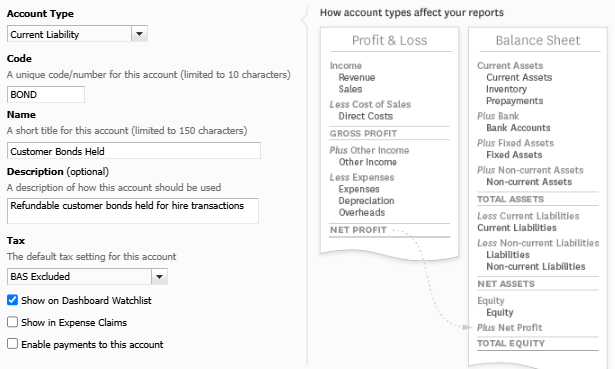
Xero identifies a Current Liability account as a CURRLIAB account. This is separate from a Bank account and from Xero's Accounts Receivable account.
The purpose of the Customer Bonds Held account is to show the total value of refundable bonds currently held by the business.
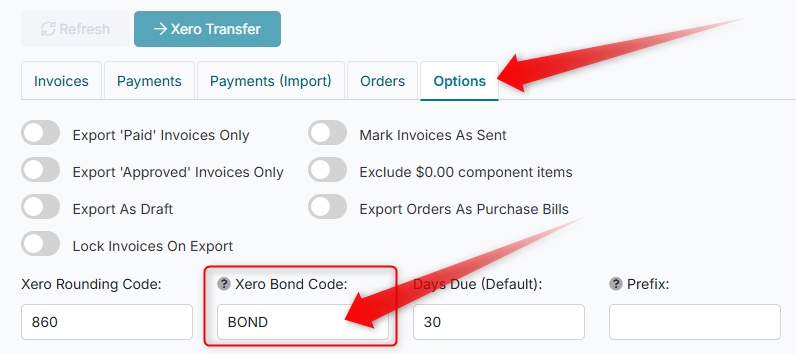
In the HirePOS > Xero Exporter, click the Options tab and enter the code you used for the Xero "Customer Bonds Held" account into the "Xero Bond Code" field.
Bank and clearing accounts
Your normal HirePOS payment accounts should continue to represent where money is actually received or refunded.
Examples include:
ANZ Bank
Commonwealth Bank
EFTPOS Clearing
Cash Clearing
PayPal
Other payment clearing accounts
The payment account answers:
Where did the money go?
The Customer Bonds Held account answers:
Why are we holding the money?
Keeping these two concepts separate makes bank reconciliation considerably easier.
Example: $1,000 invoice plus $500 bond
A customer has:
Hire invoice: $1,000
Bond required: $500
Total paid: $1,500
The customer transfers the full $1,500 into the ANZ bank account.
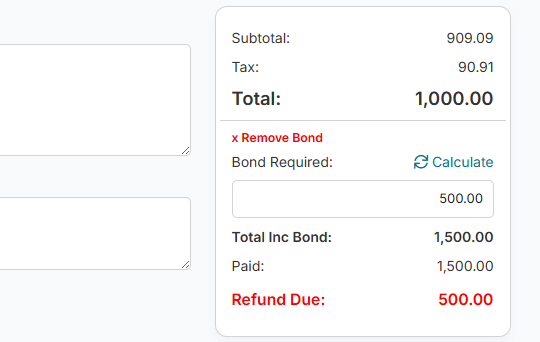
HirePOS records this as two separate payment transactions:
HirePOS transaction | Amount | Payment account |
|---|---|---|
Payment Received | $1,000 | ANZ |
Bond Received | $500 | ANZ |
Although the customer made one $1,500 payment, HirePOS separates the invoice payment from the bond for accounting purposes.
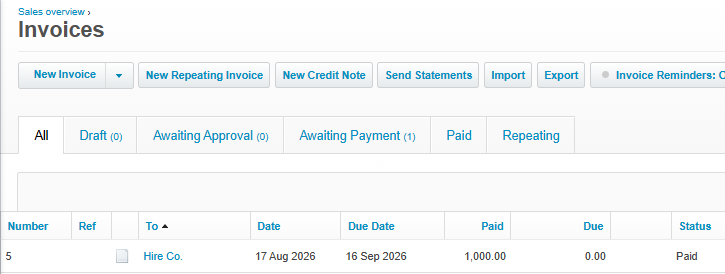
Invoice payment
The normal $1,000 payment is exported to Xero against the invoice.
The accounting effect is:
Debit ANZ Bank $1,000
Credit Accounts Receivable $1,000
The Xero invoice is therefore fully paid.
Bond received
The $500 Bond Received transaction is exported separately.
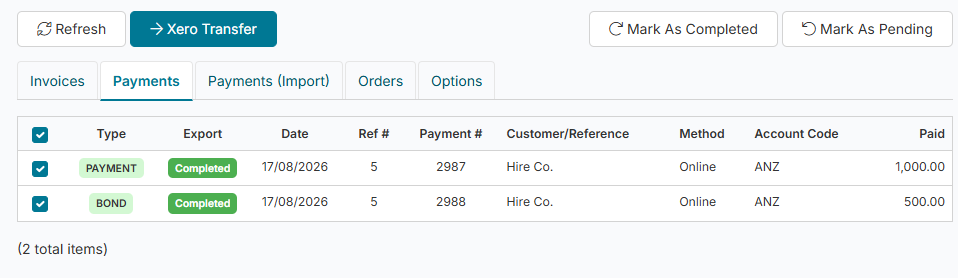
The accounting effect is:
Debit ANZ Bank $500
Credit Customer Bonds Held $500
The bond is not treated as additional invoice revenue and does not increase the customer's Accounts Receivable credit balance.
After both transactions have been exported, the ANZ account in Xero contains transactions totalling $1,500.
The Customer Bonds Held account has a $500 liability balance.
Branch Tracking for Bond Transactions
If the Invoice has a Branch with a Xero Tracking Category assigned, HirePOS includes that Branch Tracking on the Bond Liability Bank Transaction exported to Xero.
For more info, see https://docs.hirepos.com/en/articles/4632641#branch_tracking_categories_on_bonds
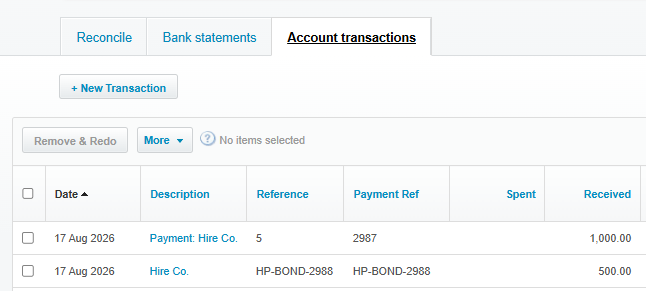
Reconciling one $1,500 bank deposit
The bank statement may contain only one deposit:
ANZ deposit: $1,500
Xero contains:
$1,000 invoice payment
$500 bond receipt
When reconciling the bank statement, use Xero's Find & Match functionality to match the single $1,500 bank statement line against both transactions.
The combined amount is:
$1,000 + $500 = $1,500
This allows the actual bank deposit to reconcile while still maintaining the correct accounting treatment for the bond.
Refunding a bond
When the customer's equipment is returned and the bond is refunded, record a Refund Bond transaction in HirePOS.
For example:
Bond originally received: $500
Bond refunded: $500
Refund account: ANZ
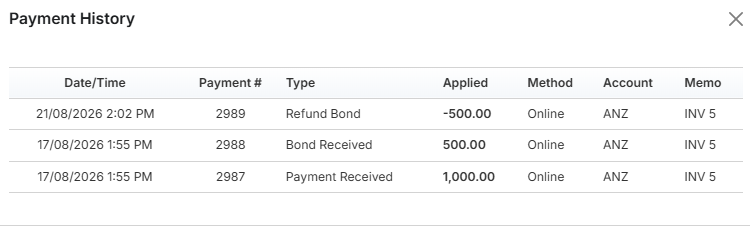
HirePOS exports the refund from ANZ and reduces the Customer Bonds Held liability.
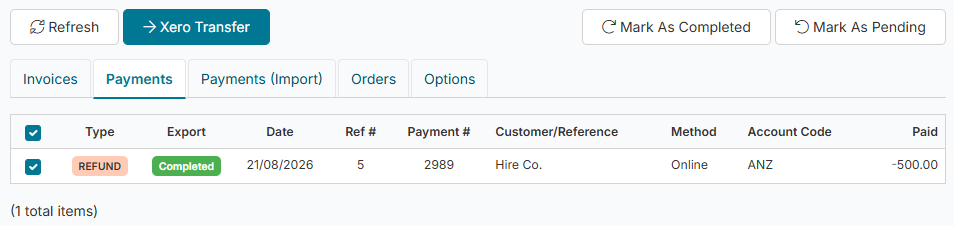
The accounting effect is:
Debit Customer Bonds Held $500
Credit ANZ Bank $500
The Customer Bonds Held balance relating to this hire is now zero.
The customer's Xero invoice remains paid and is unaffected by the bond refund.
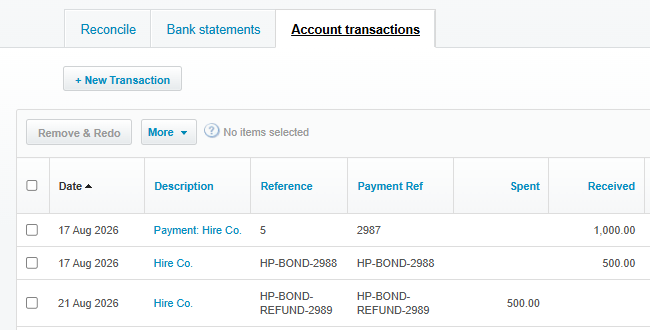
Example: bond received by bank transfer and refunded by EFTPOS
The bond does not need to be refunded through the same payment method used to receive it.
For example:
Bond received
The customer transfers a $500 bond directly into ANZ.
Accounting:
Debit ANZ Bank $500
Credit Customer Bonds Held $500
Bond refunded
When the equipment is returned, the customer requests an immediate EFTPOS refund.
The HirePOS Refund Bond transaction is recorded against the EFTPOS account.
Accounting:
Debit Customer Bonds Held $500
Credit EFTPOS Clearing $500
The Customer Bonds Held balance returns to zero.
The next EFTPOS merchant settlement may consequently be reduced by the $500 refund, allowing the EFTPOS Clearing account to reconcile normally.
This is expected behaviour. The account used to refund a bond does not need to be the same account through which the bond was originally received.
Example: cash bond
A customer pays a $500 bond in cash.
HirePOS records:
Bond Received: $500
Account: Cash Clearing
The accounting effect in Xero is:
Debit Cash Clearing $500
Credit Customer Bonds Held $500
When the cash is later deposited into the bank account, the Cash Clearing account can be cleared using the normal banking process.
If the $500 bond is subsequently refunded in cash:
Debit Customer Bonds Held $500
Credit Cash Clearing $500
Example: partial bond refund
A customer originally pays a $500 bond.
Accounting:
Debit Bank/Clearing Account $500
Credit Customer Bonds Held $500
After the hire, $400 is refunded and $100 remains held or requires further processing.
The $400 refund produces:
Debit Customer Bonds Held $400
Credit Bank/Clearing Account $400
The remaining balance in Customer Bonds Held is:
$100
A later transaction can clear the remaining $100 according to the reason it is retained or refunded.
If any part of a bond is retained for damage, additional hire charges or another chargeable amount, consult your accountant regarding the appropriate invoice, GST and accounting treatment.
Viewing bond activity from the Xero invoice
A Bond Received transaction is not an invoice payment and therefore is not allocated directly against the Xero invoice.
This is intentional.
Allocating the bond directly against the invoice would affect Accounts Receivable and could cause the invoice to appear overpaid.
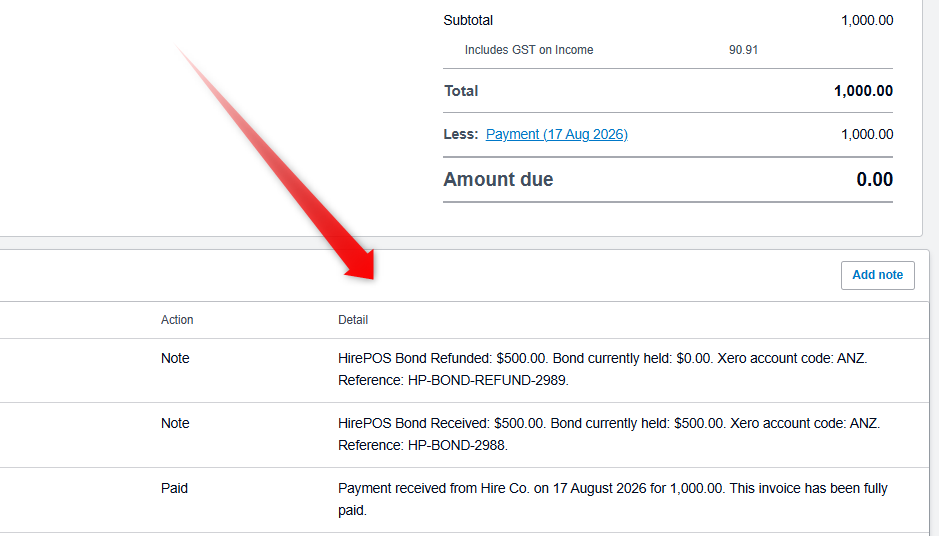
Instead, where supported by the HirePOS Xero integration, HirePOS adds an entry to the Xero invoice's History & Notes.
For example:
HirePOS Bond Received: $500.00. Bond currently held: $500.00. Reference: HP-BOND-123456.
When the bond is refunded:
HirePOS Bond Refunded: $500.00. Bond currently held: $0.00. Reference: HP-BOND-REFUND-123457.
This provides a visible audit trail from the Xero invoice without changing the invoice balance.
Why bonds are not treated as Xero overpayments
A customer overpayment generally represents money received in excess of an Accounts Receivable invoice balance.
A refundable hire bond has a different purpose.
The business is holding the money temporarily and normally expects to return it to the customer.
For this reason, HirePOS can treat the bond separately from:
invoice payments;
Accounts Receivable;
sales income; and
Xero customer overpayments.
Xero provides separate Bank Transaction types for ordinary money received and spent, including RECEIVE and SPEND, as distinct from its dedicated overpayment transaction types.
This allows the bond to be allocated to a Current Liability account while the actual bank or clearing account still records the movement of funds.
Recommended account structure
A typical business may therefore have the following Xero accounts:
Xero account | Purpose |
|---|---|
ANZ Bank | Actual funds held in the ANZ bank account |
EFTPOS Clearing | EFTPOS receipts and refunds awaiting settlement |
Cash Clearing | Cash received before banking |
Customer Bonds Held | Outstanding refundable customer bonds |
Accounts Receivable | Outstanding customer invoices |
Sales/Hire Revenue | Income from hire and sales invoices |
The Customer Bonds Held account should generally be configured as a Current Liability rather than a Bank account. Xero supports Current Liability accounts separately from Bank accounts in its Chart of Accounts.
Recommended reconciliation check
As an accounting control, the total value of outstanding refundable bonds in HirePOS should broadly reconcile to the balance of the Customer Bonds Held account in Xero.
For example:
HirePOS hire | Bond currently held |
|---|---|
Hire 1001 | $500 |
Hire 1002 | $250 |
Hire 1003 | $750 |
Total bonds held | $1,500 |
The corresponding Xero Customer Bonds Held account should show approximately:
$1,500 liability
Differences may indicate:
a bond that has not yet been exported;
a refund that has not yet been exported;
a transaction manually edited or deleted in Xero;
an incorrect account mapping;
a bond that has been retained or applied to another charge; or
a transaction awaiting further processing.
Frequently asked questions
Should I create a separate invoice for the bond?
Generally, no separate HirePOS invoice is required simply to collect a refundable bond.
HirePOS can calculate the required bond and record the Bond Received transaction independently from the hire invoice.
This avoids requiring staff to manually determine and enter a separate bond invoice.
Should the Customer Bonds Held account be a Xero Bank account?
Normally, no.
The bank or clearing account represents where the money is located.
Customer Bonds Held represents the amount owed back to customers and is therefore normally configured as a Current Liability account.
Can a bond be paid together with an invoice?
Yes.
For example, a customer can make one $1,500 payment consisting of:
$1,000 invoice payment; and
$500 bond.
HirePOS separates these into the appropriate payment records while preserving the total amount received.
Can one bank statement transaction be matched against the invoice payment and bond?
Yes.
If the bank statement shows one combined deposit, use Xero's Find & Match functionality to select the corresponding transactions whose combined total equals the bank statement amount.
Can a bond be refunded from a different account?
Yes.
For example, a bond may be received by direct bank transfer and later refunded using EFTPOS.
The Customer Bonds Held liability connects the accounting transactions; the original payment method does not need to match the refund method.
Does a Bond Received transaction make the Xero invoice overpaid?
No.
When the bond is treated as a separate bank transaction allocated to Customer Bonds Held, it does not change the Accounts Receivable balance of the invoice.
How can I see the bond when viewing the Xero invoice?
Where supported by the HirePOS Xero integration, bond receipt and refund information is recorded in the Xero invoice's History & Notes.
This allows users to see the amount received, refunded and currently held without treating the bond as an invoice payment.
What happens when the entire bond is refunded?
The Refund Bond transaction reduces the Customer Bonds Held liability.
If a $500 bond was received and the full $500 is refunded, the remaining bond liability for that hire is zero.
What happens if part of the bond is retained?
The refunded amount reduces the Customer Bonds Held account while the remaining amount stays as a liability until it is subsequently refunded or applied appropriately.
If the retained amount is used to pay an invoice, damage charge, additional hire or another taxable supply, consult your accountant regarding the appropriate accounting and tax treatment.
Summary
The recommended HirePOS and Xero bond workflow separates the movement of money from the accounting purpose of the money.
A normal invoice payment:
Bank/Clearing Account → Accounts Receivable
A bond received:
Bank/Clearing Account → Customer Bonds Held
A bond refunded:
Customer Bonds Held → Bank/Clearing Account
This allows:
invoice payments to reconcile correctly;
EFTPOS and cash clearing accounts to reconcile correctly;
direct bank-transfer bonds to be handled without routine Suspense transactions;
bonds to remain separate from customer overpayments;
refunds to be made using a different payment method from the original receipt;
Xero to show the total bond liability being held; and
bond activity to remain visible from the associated Xero invoice through History & Notes.
For advice on the appropriate Chart of Accounts codes, tax rates, GST treatment or treatment of forfeited bonds, consult your accountant or bookkeeper.